I had a short break before some professional development work at school today and I decided to take a walk in the woods. Off trail and just over a tiny creek, I noticed some deciduous trees and,wondering if they might be maples, decided to have a closer look. It was swampy and I had to hop on tufts of grass, but I made it to the trees, and then decided to wiggle my way through some rose bushes to see what was beyond the swampy area. I was hoping to stumble on some morel mushrooms but instead I hiked into a deeper swamp. Too far out to turn back and not wanting to go through the thorny shrubs again, I planned to circle around towards the school but this only led into deeper water. I tried walking on dead logs and more tufts of grass but a log snapped and my foot plunged into the cold water, and I just gave up and waded through the calf-high water and bushwhacked through a thicket, arriving back at the school sopping wet and with no socks (l had wrung them out and placed them in my car window to dry) and just in time to talk with my colleagues about literature.
Wednesday, March 23, 2016

Thursday, March 10, 2016
A Walk in the Woods after Hearing of the Death of an Old Friend
I had walked onto spongy earth. Cattails and other straw-colored reeds had been matted flat onto the ground, maybe by a flood from a nearby creek, which was slightly swollen. It was early and the sun was a deep red. Behind me, the school where I teach was filling with students and in a few minutes the morning bell would ring and I'd begin teaching for the day. But, right now, I stood by the creek, recalling a time many years earlier in the Adirondacks when I sat beside a mountain stream straining to hear something; I wanted a sign that there was something greater than the water flowing quickly over slippery stones and down the mountainside. I was alone, having driven up to the mountain spot from my home on Long Island, where I lived with my mom and three sisters. I became angry and frustrated with the creek and the mountain and the woods when all I heard was silence, everything seemed so pointless, and I walked away suffering my defeat. Now I stood by another creek. The night before I received news that a friend of mine from high school had died. He was a year younger than I, and he had two children the same age as mine. I thought about the nights we spent together with friends in the woods, at house-parties, behind the medical center, smoking and drinking, laughing, telling our stories. I imagined standing beside him and telling him that in 25 years he would be gone, taken from the earth. I told him that he would have children and they would lose their father. I thought about his response and I felt sad and I yielded to all the things we cannot see. I returned to the swollen creek, looking down into the clear water which was making an oily swirl around a smooth gray branch. I could hear birdsong in the bare oaks and green pines. The air felt cold and no breeze blew. I smelled the wet, decaying earth. I didn't strain for anything beyond this. I turned a few times, looking around at it all, and then returned to school.
Tuesday, March 8, 2016
In the Woods, Past, Present and Future
March 8
I took a walk this morning in the woods next to the school where I teach, and I imagined I was in the same woods I roamed when I was a boy on Long Island, although I’m now 42 and live in the hills of western Massachusetts. I imagined these were the same pines I smelled, the same sharp air I breathed, and the same birdsong I followed, often barefoot down sandy paths. And, as I walked, I looked ahead to when I'll be an old man passing under the same bare oaks my children will someday pass under when they are old and their children will pass under when they are old, and I am gone. At some point, I noticed a coyote track, a single pawmark in the mud in the middle of the trail. The mud was soft and wet and the print was fresh. I can see the coyote leaping from the dark on one side of the trail, making a brief landing here, and then disappearing into the brush on the other side.
I took a walk this morning in the woods next to the school where I teach, and I imagined I was in the same woods I roamed when I was a boy on Long Island, although I’m now 42 and live in the hills of western Massachusetts. I imagined these were the same pines I smelled, the same sharp air I breathed, and the same birdsong I followed, often barefoot down sandy paths. And, as I walked, I looked ahead to when I'll be an old man passing under the same bare oaks my children will someday pass under when they are old and their children will pass under when they are old, and I am gone. At some point, I noticed a coyote track, a single pawmark in the mud in the middle of the trail. The mud was soft and wet and the print was fresh. I can see the coyote leaping from the dark on one side of the trail, making a brief landing here, and then disappearing into the brush on the other side.
Tuesday, July 7, 2015
Is sharing always for the best?
The few leaves the bush-bean had left were sagging and pocked with holes. Several limbs were truncated about halfway out, as if the plant had given up. I dug into an orange five-gallon pail and cupped a handful of compost. I had already dropped and dug in 12-pails of compost around the stems of tomatoes and corn. Now, I had a three pails left and I had to be selective.
This plant obviously needed compost. Each batch is a mix of kitchen scraps, wood-ash, lawn-clippings, dried and green leaves and lots of weeds, giving plants the nutrients and bacteria they need to grow and produce.
But this one is weak. Other stronger plants stand a better chance of using the nutrients in the compost to produce a bigger harvest. When you have a limited supply, sharing with the weak seems to be a waste.
Yes, this is what I thought as I kneeled over the that needy plant. And, taken out of the chicken-wire fence of the garden, it’s an ugly thought. But this is what gardening does sometimes: It brings up the worst thoughts in me. Like the time I fantasized about catching the eastern cottontail—yes, he’s the eastern cottontail—in a Have-A-Heart cage and shooting it with a pellet gun. Ironic and ugly, I know.
But he ate my Swiss chard!
And here I now was choosing which plants deserve health. I had already decided that tomatoes came first because they are now producing fruit. Then, the corn, because they need plenty of energy to grow so tall. Beans were third in line because they are about to produce.
And because I only had a small amount of of compost left, the beans would have to share.
But that’s the thing: Should I?
If I share, the weaker plants could bounce back and in the end I’d have a greater yield. On the other hand, the weaker plants could continue to wither, stealing nutrients from the healthier ones, and in the end, I’d have a smaller yield.
Sharing is a gamble.
So, what did I do? I shared. Well, not quite. The truth is a few plants got just a little less.
Sunday, June 28, 2015
On Suburban Maryland Roads: Hunting for Berries, Bypassing 'World Famous' Strip Clubs, Suffering Poison Oak (On the Forehead), Finding a Fox Finding Me, Reflecting on the Addiction of the Finder's Joy, and Returning with the Booty

We were visiting my sister, Jennifer, from our home in Holyoke, and once we arrived, I headed outside to have a look around. My sister and her family (a husband named Dave and a baby daughter named Bridget) live in a suburban neighborhood just outside of Baltimore, on a street shaped like an oxbow, a tiny teardrop of a road branching off of the Patapsco River.
Out back, there's a sump and along its edge a patch of woods where I guessed I might find some berries. Starting here, I quickly noticed one of my favorites, blackberries. It was a bit early in the season, so my son, Paddy, and I had to search up and down the thorned canes to find the darker berries. We did, picking several mouthfuls and then continuing our search.
Through a tiny path at the end of the street we headed, stepping over a steel culvert that directed a stream towards the river, and walking into a development of row houses. Here, we picked our way through bramble after bramble that framed the road, and not far ahead, we spotted low-growing bushes with light-green, oval leaves, and on the end of each branch, blueberries.
We paused, admiring our find. A low-bush blueberry is only a little bigger than a pea, so to get as much flavor as possible, we filled our palms with them before eating a handful. Cars slowed to watch the two grazers, and I got the sense they didn't know about all the wild fruit growing outside their doors. (Or, they were wondering about these two out-of-towners picking all their berries.)
Either way, their watching eyes didn't slow us down. Because once you start picking, it's hard to stop. It's an obsession that isn't just about the sweet reward. Before your tongue even bursts that perfect berry against "your palate fine," some other joy pops in your brain when you see the reward; this happens a moment before you pluck the berry from its vine, and it's this finder's joy that charges your search. I suspect some ancient evolutionary response wants to keep us scavengers out there in the hot sun hour after sweaty hour hunting for food-- and the addiction works!
In fact, I was so intent on foraging that I not only ignored the nosy neighbors but I even missed the poison oak when its oily leaves brushed my forehead as I rooted through the berry bushes. Yes, I said "my forehead!" And by nightfall, blisters bubbled up, one pimply pocket at a time.
But all this came to pass much later. In the moment, under the sun, on the wood's edge, my son and I were in bliss. Happily we noshed. Eventually, we had to drag ourselves away from the blueberry patch and out towards other finds.
We headed up and out of the townhouses and onto a busy main road.
Across from us was an 84 Lumber and beside that, a storage facility and a do-it-yourself car wash. Stretching down the road was an occasionally-gapped wall of other one-story businesses: a recycling center, asking for brass, copper and aluminum, a restaurant called Beefalo Bob's with a flashing neon sign advertising karaoke night, a strip club with dark-mirrored windows (one shattered) calling itself The World Famous McDoogles, a bail bondsman offering "the lowest" interest rates and a little farther down, beside a tiny drawbridge, a marina peddling steamed Maryland crabs ("too pricey," my sister said) and a tiny one-room wings and sub shop (in a spot where "restaurants go to die"). Behind the stores was a backdrop of woods where two industrial smokestacks puffed out white clouds of steam. High-power lines stretched back to the smokestacks, making a greenway where one evening I spotted a red fox watching me.

Paddy and I walked a little ways and then turned off the main road and headed back towards my sister's, where we stopped at some abandoned buildings. "Check that out," I said. The white-stucco shacks were once summer bungalows. As my sister explained, many of the neighborhood's bungalows were long ago purchased by factory workers from Bethlehem Steel (at a time when the Patapsco River was polluted and river-front property was cheap) and they are now being purchased again, torn down and turned into million-dollar homes, squeezed onto tiny water-front plots on a river more pristine.
 These three shacks sat in a line down to the river's edge. Their yards were overgrown with sumac and oak and another tree which had what looked like four-foot-long pole-beans hanging down. Vines wound tightly around the trunks. Green plants of various types--some blossoming yellow and white flowers--covered where grass once grew, and along the edge of the road were the last fruits of the day, mulberries.
I jumped and grabbed a tree branch, pulling the berries down to us and soon our fingertips were stained with the dark purple juice. After picking the lower branches clean, we stood under the tree, looking up at mature berries hanging from the higher branches. "I can climb it," my son said. Although he's only four, I didn't doubt him, and I considered giving him a boost to help him scale up to the enticing upper berries.
But I thought better of it and walked back to my sister's.
Saturday, May 2, 2015
Finding Fiddleheads without Breaking the Law

I have a confession to make. So, I was down by the Connecticut River at the spot where I knew ostrich ferns grow. They were in a gully where a culvert poked out of a section of the Manhan Bike Trail and I had gone there last summer when the massive ferns were fully unfurled reaching well above my head.
I hiked down and checked their stems and found they had the telltale groove that made them look something like a celery stalk.

I was excited to have found a spot to harvest the fern's edible fiddleheads next spring, and this is where I found myself this morning: standing in the same gully, poking through the leaf litter with a stick and finding the coiled fiddleheads.
Yet, I also found a sign. It said: Conservation Area: Do Not Disturb Plants. What? This sign was not here last year. It was not attached to a tree, just a big piece of bark, which was propped up on a concrete section of the culvert. I walked over and flipped the sign over so if anyone came around I could plead ignorance: What sign?
I bent down ready to pluck my first fiddlehead, but then my four-year-old son, Paddy, who was surprisingly quiet up until this moment, asked me a question: What did that sign say?
I could lie. Say it was just something the river washed up. It was a For Sale sign. A Tag Sale sign. And then have him return to breaking the law with his father. Our first shared crime.
Yes, the thought darted--very quickly--across my conflicted mind and I am not proud ... But, fiddleheads are so hard to find and I was running out of time; in a day or two they would unfurl and I would have to wait another year and maybe I would never find them again; last year I wrote a story about a forager who had been finding wild edibles in the Valley for some 20 years and he said he had never found the fiddlehead from an ostrich fern-- never!
Moreover, before you judge me, please remember these thoughts were all happening within a span of about 30 second, and in the end, I could not lie and break the law. (If he was not there, who knows?)
"It says we can't pick here," I said.
"I told you so," he said, reminding me that he had told me earlier that we needed to go to a new spot, not one we had already visited.
And that is what we did. We drove up to Route 5 in Northampton and explored the shoreline which the Connecticut River regularly floods and then recedes from; this is the type of wet soil ostrich ferns grow in. We walked around, carefully stepping over driftwood and bottles and Styrofoam coolers. We walked up onto a hill where there was some sort of generator behind a fence and there we spotted a stand of fiddleheads, but they were already unfurled.
We settled for the satisfaction of finding a spot for next year, and we were walking out, snacking on garlic mustard along the way, when I saw a few ferns sticking out of piles of branches pushed up by the river.
"That might be more ostrich ferns," I said.
We walked over and sure enough the whole area had the giant fiddleheads, curled up just below the sticks.
We stayed for about a half hour, picking a few from each bunch and leaving the rest to grow and reseed next year's crop. The stand was three times the size of the former spot (with no guilt attached to it). We brought our harvest home, cleaned, washed and boiled them for about 15 minutes and then pickled the whole bunch, enough for a couple of months.
So today, honesty paid, and ended with a jar of pickled fiddleheads.

Sunday, April 26, 2015

Ramp Recipes--Told Super Fast

My four-year-old is begging for the laptop. My almost one-year-old is pulling down the curtains. And this is my life. So, if I am going to blog I must be quick. So hear it is, three ramp recipes told super quick.
1st-- Ramps are wild leeks. They grow mostly in neutral damp woods, best spot under maples.
Recipe 1-- Ramp bread.

3 cups flour.
2 teaspoons yeast.
2 teaspoons salt.
Mix in food processor, add water until dough is a wet ball, drop in oiled bowl, shape into a ball (it should be really sticky), wrap with plastic, let rise about 3 hours.
Ramps
Quickly saute greens and bulbs in a little oil to soften up and take some of the bit out of. Set aside and let cool.
Ramp Bread
After first rising, lay dough ball flat on floured surface, rub ramps over the top (as if it's a pesto pizza), kneed.
I kneed in a circle, working around the dough ball and pressing it down with the heel of my hand.
Kneed one full circle or so. Shape dough ball into the bread you want. Place on floured baking sheet. Lightly flour and cover with a small towel. Let rise for another hour.
Take out after one hour, Slice top three or four times with knife. Make an egg wash with egg whites. Brush wash over the bread; this will give it a brown color.
Preheat oven at 450. Place in bread. Spray or flick some water on the walls to create a humid chamber. Cook for about 10 minutes.
Lower heat to 350. Cook for another 20 min. or so, until when you knock the back of the bread, it sounds hollow.
All done!
Next- Ramp Pesto (I have to move faster; my kids have blankets over their heads and they are walking into walls.)

Place ramp bulbs and greens in food processor. Pulse until finely chopped.
Add what you like: Olive oil. A little honey or sugar. A pinch of salt. A little pepper. Pine nuts if you want (I don't). A sprinkle of Parmesan cheese.
Enjoy!
Last (and my favorite)-- Pickled Ramps
Pickle Solution
2 cups of water.
1 cup of vinegar.
1 cup of sugar.
2 table spoons of salt.
Boil until everything dissolves.
Meanwhile, cut off ramp bulbs at about one inch, make sure to include the red spot at the stem. Blanch and then place in pickle jar.
Pour hot pickling solution over ramps. Let cool. Seal. Refrigerate. Love.
That's it! Forgive the typos. My kids just walked (and crawled) out the front door. I'm off!
Friday, April 24, 2015
Finding wild ramps (I think) on a strange and beautiful hike

We stood at the top of a steep hill, just off an abandoned railroad track. This was the spot. I had noticed it from the road and had a feeling we'd find ramps here. I looked around: no pines (ramps dislike the acidic soil pines grow in). A corroded pipe jutted out from the embankment near the street, allowing a stream to pass underneath and into the tiny valley. Ramps grow in such moist soil.
Paddy and I climbed down, digging our heels in with each step. Once down, we had to cross a bridge made by a fallen tree to get to the other side of the stream. It was about six feet up and Paddy carefully balanced his way across, while I followed behind.
On the other side, we began to roam.
Paddy found an uprooted oak tree and I told him that some people believe such roots are the best place to look for rare rocks and long-ago buried treasures. He went to work poking his hand into the roots, searching for his treasure.

We soon continued on and I noticed some light green leaves, in a small patch, poking from the ground. I immediately knew they were ramps. I snapped one at the root and smelled. Ramps are a wild leek and they smell like onions. I smelled onion.
I looked around and saw a few other patches. I dug up a few plants in each, careful to leave enough to go to seed, so they could produce more later on. I stuffed the ramps in my backpack next to some garlic mustard I had already picked and we moved on towards the culvert that Paddy wanted to check out.
The ramps were the climax of a strange hike, marked by beautiful and weird sights, like a miniature forest of tiny white flowers ...

and a root that looked like a giant snake ...

and the abandoned house crushed by a tree, set right in the middle of the woods ...

and a sea of mesmerizing plants growing from the leaf litter ...

Finding ramps would have been a perfect finish and I had big plans. I wanted to pickle them with some fiddleheads I plan to pick in a couple of days. We quickly headed home, with Paddy in the lead.

My plans lasted the whole way, until we reached home. This was when I called out to Lisa.
"I found ramps!"
She was on the couch with Gabo sleeping on her chest. I brought her in one to smell.
"Smells like onion, right?"
"I don't smell onion," she said.
What did she mean? How could she not smell onion?
I smelled it again. The scent was not as pronounced as when I picked it in the woods, but I smelled onion.
But now, I needed to be sure. Lily of the Valley looks like ramps and is poisonous. I read online that sometimes when you pick ramps with garlic mustard, the onion scent is from the garlic mustard, not the ramps. "So be careful" was the message.
I wasn't so sure anymore.
I grabbed one of my books. It said that ramps have a red or purple color at the base. Mine were pure white; it was not looking good. I decided to bag the "ramps" for the day. Tomorrow, I would bring them to my father-in-law, Thom Smith, a nature writer who lives in Pittsfield. He'd know.
To be continued ...
Wednesday, April 22, 2015
But How? Waiting for the Seedlings
 |
| A pea breaks through. |
When I drop the tiny dry seed into the grooved earth, no deeper than a finger nail, and cover it with soil and pat dirt down, I sit and doubt. I doubt a plant will ever come from this. I do not articulate these doubts. I feel them. A skepticism directed at the seed and the earth. I just do not see how something that lay packed away in a drawer or stacked on top of the living room bookcase, sometimes for more than a year, how from this anything could grow, let alone in dirt often strewn with rocks and sticks. And yet, I water the rows and the hills and I wait. I get down on my knees and scrape away the top layer of shredded leaves and little sticks and I check. And then, there it is, the light green shoot, just beyond the dirt's crust, sometimes wearing its seed casing like a crown, and I sit there and still I doubt. I feel the impossibility of how something so fragile, something that could be plucked free with no effort, could survive spring's downpours, could go unnoticed by the eastern cottontail, could by-pass the tree-root and rock below, could grow strong and bear leaves and fruit; how? And yet, each year they come and they grow and my doubt is replaced by joy.
The Alchemy of Making Black Gold
Each spring my thoughts turn towards dirt. I get down on my knees and run my hands through it, searching for worms. I squeeze it to see if it crumbles or keeps.
I go to the compost piles: the quick-turning one that takes in kitchen scraps and the slow-churning one that eats yard waste.
I shovel out spades-full, using it to fill in trenches for beets and parsnips. I mix it into the lazy bed for the potatoes. I make new gardens.
Dirt is the foundation.
And, for me, it starts in the sky, far out of reach ...

… with the trees.
My suburban home is surrounded by them. Which, come fall, can be overwhelming. Each tree sheds at a different time, laying down layer after layer of leaves, and I barely keep up with raking.

Just the thought of bagging them is exhausting. So, out of laziness a few years ago, I dragged them with a tarp and dumped them in a corner of my backyard, hoping they would go away.
Maybe, they'd turn into soil which I could use in my gardens.
A friend soon shot this down. They're oak leaves, he explained, which contain tannin. The acid in tannin would poison my plants.
To protect my laziness, I needed to debunk this. And, luckily, I soon did. I discovered that tannin dilutes out over time, especially when mixed with other yard waste.
Not only that but oak leaves can improve soil, as Kentucky State University research and extension horticulturist, Ward Upham, said: “Oak leaves can become a good source of soil nutrition.”
Yet, Upham warned that the leaves can take a while to breakdown. Thankfully, a lawnmower solves this problem.
Here’s what I do: I rake the leaves into piles and then run the mower over them a few times, shredding them into a fluffy mix of tiny pieces, which I layer into the compost pile with other yard waste.

I make sure to wet and flip the pile throughout the year, helping the material breakdown.
Then, before winter, I cap it by tossing some dirt from the sides over the top. The swollen hill--filled with leaves and grass and forsythia branches and sod--cooks for a couple of years and then pours out black gold, perfect for plants.

The late poet Seamus Heaney captured the joy of cutting into such fine earth (for him it was peat in the bogs of Ireland) in his poem “Digging”:
The cold smell of potato mould, the squelch and slap
Of soggy peat, the curt cuts of an edge
Yes, more than the need for compost for the plants and more than the need for dirt for the new garden--there is just that sound, the slide of the spade slipping into soft earth.
I go to the compost piles: the quick-turning one that takes in kitchen scraps and the slow-churning one that eats yard waste.
I shovel out spades-full, using it to fill in trenches for beets and parsnips. I mix it into the lazy bed for the potatoes. I make new gardens.
Dirt is the foundation.
And, for me, it starts in the sky, far out of reach ...
… with the trees.
My suburban home is surrounded by them. Which, come fall, can be overwhelming. Each tree sheds at a different time, laying down layer after layer of leaves, and I barely keep up with raking.
Just the thought of bagging them is exhausting. So, out of laziness a few years ago, I dragged them with a tarp and dumped them in a corner of my backyard, hoping they would go away.
Maybe, they'd turn into soil which I could use in my gardens.
A friend soon shot this down. They're oak leaves, he explained, which contain tannin. The acid in tannin would poison my plants.
To protect my laziness, I needed to debunk this. And, luckily, I soon did. I discovered that tannin dilutes out over time, especially when mixed with other yard waste.
Not only that but oak leaves can improve soil, as Kentucky State University research and extension horticulturist, Ward Upham, said: “Oak leaves can become a good source of soil nutrition.”
Yet, Upham warned that the leaves can take a while to breakdown. Thankfully, a lawnmower solves this problem.
Here’s what I do: I rake the leaves into piles and then run the mower over them a few times, shredding them into a fluffy mix of tiny pieces, which I layer into the compost pile with other yard waste.
I make sure to wet and flip the pile throughout the year, helping the material breakdown.
Then, before winter, I cap it by tossing some dirt from the sides over the top. The swollen hill--filled with leaves and grass and forsythia branches and sod--cooks for a couple of years and then pours out black gold, perfect for plants.
The late poet Seamus Heaney captured the joy of cutting into such fine earth (for him it was peat in the bogs of Ireland) in his poem “Digging”:
The cold smell of potato mould, the squelch and slap
Of soggy peat, the curt cuts of an edge
Yes, more than the need for compost for the plants and more than the need for dirt for the new garden--there is just that sound, the slide of the spade slipping into soft earth.
Monday, April 20, 2015
Digging Out The Beds and Making Fluffy Soil
The first veggie-garden is complete. My four-year-old son, Paddy, and I shoveled two trenches about one foot down and 20 feet long, sifted the sticks and rocks out of the dug-out dirt (we used some chicken wire draped over two workhorses; the wire caught the rocks and wood but let the fluffy dark soil sift through), filled the trenches back in and now they're ready for turnips and beets.

We worked compost into rows for kale, broccoli and brussels sprouts ...

... and set aside room for three tepees for beans, which we'll make from some massive branches that a white pine next to my house shed this winter. We made three big hills for spaghetti squash and cleared spots for flowers, including a small patch of giant sunflowers. We transported some wild raspberry vines we found in the woods to a corner near wild low-bush blueberries that we found on a hike and dug up and planted at the end of last year, and we are anxiously waiting to see if they took. ... These are days when I do not have to read in bed at night because I just lie there thinking about the garden.
We worked compost into rows for kale, broccoli and brussels sprouts ...
... and set aside room for three tepees for beans, which we'll make from some massive branches that a white pine next to my house shed this winter. We made three big hills for spaghetti squash and cleared spots for flowers, including a small patch of giant sunflowers. We transported some wild raspberry vines we found in the woods to a corner near wild low-bush blueberries that we found on a hike and dug up and planted at the end of last year, and we are anxiously waiting to see if they took. ... These are days when I do not have to read in bed at night because I just lie there thinking about the garden.
Spring's First Forage
The fiddle heads have almost popped up from last year's stems. My four-year-old son, Paddy, and I found them last year in a gully down by the Connecticut River. The gully is made by a culvert that runs under East Street in Easthampton, and last year we found the massive ostrich ferns, fully unfurled and filling in the tiny valley. Soon the furled fiddles will be ready to be picked. I haven't cooked them before so I'm looking forward to see how they taste.

Along the way we also found garlic mustard, good for a bitter pesto that I tame by adding a little sugar, and what I believe is immature watercress growing in a tiny intermittent stream running alongside the Manhan Bike Trail. We couldn't be sure about the watercress so in the end we didn't' eat them; if you can help me identify them, they're the last picture.

Along the way we also found garlic mustard, good for a bitter pesto that I tame by adding a little sugar, and what I believe is immature watercress growing in a tiny intermittent stream running alongside the Manhan Bike Trail. We couldn't be sure about the watercress so in the end we didn't' eat them; if you can help me identify them, they're the last picture.
Saturday, April 4, 2015
Broken Nest
A couple of weeks ago, Lisa walked me to the sliding glass door. "Look" she said, pointing at our vegetable garden: A squirrel, its mouth stuffed with leaves, scurried over the roof of the garden shed and slipped through a tiny hole at the top of the doors. "Shit," I said. "It's making a nest." Two days later, I shoveled some snow from in front of the doors, pulled them open, and stood looking at a globe of tightly wound leaves, string, a pair of stockings and dried grass, and poking out of the center like a tiny ball, a squirrel's head, darting left to right. "Back up, Patrick," I said, having a cartoonish vision of the squirrel jumping out and latching onto my son's face like a starfish. "It's just a squirrel," he said, not listening. I knew I had to get the squirrel out of the shed because spring was coming and I had all my garden tools in there, so I poked the nest with a shovel, but the head just dove inside. I could have walked away. Keeping the door open. The squirrel would have scattered, but I was curious. I wanted to see the squirrel again. I hooked the nest with the shovel and pulled and the squirrel shot into the air like a water-rocket. "Run," I screamed at Patrick. He walked back a few steps, watching the squirrel dart up a tree. And then, the cries. Tiny high pitched whimpers. Coming from the broken nest. "Patrick," I said. "Go inside." "Why?" he asked. "Just go inside." He listened this time and walked away. I stepped closer and looked down, pink and bare, the baby squirrel on the white snow. In the shed, there were three more. I looked at the sliding glass door, where Lisa stood with Patrick. I raised my arms. "What?" Lisa said. I couldn't speak. I just raised my hands again. The mother made noises from a branch on the white pine above me. What had I done? I mouthed the words "babies" to Lisa and then I looked back at the shed. I bent down and scooped the baby on the snow onto a piece of cardboard. I tried to place it back onto the shelf where the tangled globe once was, but its leg snagged a piece of string and it hung there above its siblings, swaying frantically. I juggled its leg loose and it fell with the others, all crying now; the mother making noises above. I did not know what to do. I covered them with the leaves that had fallen onto the snow, closed the door and walked away. Inside, I did a Google search and read that the mother may return to take the babies away if you leave the nest alone. I did, for two days, and then returned. I opened the door, feeling uneasy about what I might find. I flipped through the leaves, and the string. Nothing. The babies were gone. Thankfully taken away.
Tuesday, March 17, 2015
Muddy Hands Bring Hope for Warmer Days
 |
| The snow has melted and we raked and cleared the front flower garden. |
After a long cold winter, today I got some dirt under my finger nails. While my backyard is still covered in snow, the sun has melted about half of the front, exposing one of my flower gardens. I raked away some pine needles leftover from fall and started to pull out some of the dried weeds. There was the oregano, still green. Paddy tore off a leaf and tasted and I followed suit. We both got on our hands and knees crawling as close as we could to the dirt. There was the raspberry vine; we'll move that to a better spot this weekend. We found a tiny silvery leaf of sage, on a thin-legged stem, poking out. With the sun on our backs, we worked our way around the small garden, picking and pulling and noticing. After some time, we got up and picked up branches and twigs shed by the scrub pines in the front and carried them to the fire pit in the back to be dried out in the sun; this weekend we'll make a fire.
 |
| Below the PVC pipes the snow is shoveled and the ground is thawing. Soon, I'll plant the snow peas. |
Then we dug the ice and snow from the top of the compost pile, finding that the dirt below was soft and easy to dig into. A few feet away, we scraped out a line of snow where we'll plant our peas as soon as the ground thaws. We kept on this way until our feet were too cold and we returned inside, with muddy hands and knees.
Thursday, July 31, 2014
Wild Visitor: Waiting for Gray Fox's Return
Thursday, July 31. 5:30 a.m.
I sit on a small couch with my son Patrick squeezed beside me. He's watching My Little Pony on a laptop as I read. But, my periphery stands guard, looking out the front door.
I see a hydrangea flower, a lavender globe in the lower left of the door's frame; its backdrop is the grooved bark of a pitch pine, straight-backed and rising out of the frame.
Buddhist flags, a string of color (blue, white, red, yellow and green) cross the entire frame, ending before complete.
Beyond, a flower garden, a few orange lily buds yet to bloom, and a giant sunflower at the edge of the empty road, its face turned towards light to come.
I imagine the gray fox stepping into this frame as it did two days earlier.
I picture its shy but swift step materializing bit by bit from behind the pitch pine, crossing in front of the flower garden, under the flags, a moment so brief, as it comes-- and then I leap!
"What are you doing?'' Patrick calls, as I run to the door.
"The fox, I thought I saw the fox."
A tumble of gray limbs had streaked across the frame. I open the door and step outside.
The air is cold.
I walk around the corner of the yard, my nerves alert. I flinch when a branch cracks underfoot.
I look around the back, down the forsythia edge.
Was it a bird? I wonder. Was it my imagination?
I go back inside, returning to my place on the couch, next to Patrick, who returns to My Little Pony.
And I look to the pitch pine, under the Buddhist flags, and sense the moment is already gone.
 |
| The above image is not mine. |
I sit on a small couch with my son Patrick squeezed beside me. He's watching My Little Pony on a laptop as I read. But, my periphery stands guard, looking out the front door.
I see a hydrangea flower, a lavender globe in the lower left of the door's frame; its backdrop is the grooved bark of a pitch pine, straight-backed and rising out of the frame.
Buddhist flags, a string of color (blue, white, red, yellow and green) cross the entire frame, ending before complete.
Beyond, a flower garden, a few orange lily buds yet to bloom, and a giant sunflower at the edge of the empty road, its face turned towards light to come.
I imagine the gray fox stepping into this frame as it did two days earlier.
I picture its shy but swift step materializing bit by bit from behind the pitch pine, crossing in front of the flower garden, under the flags, a moment so brief, as it comes-- and then I leap!
"What are you doing?'' Patrick calls, as I run to the door.
"The fox, I thought I saw the fox."
A tumble of gray limbs had streaked across the frame. I open the door and step outside.
The air is cold.
I walk around the corner of the yard, my nerves alert. I flinch when a branch cracks underfoot.
I look around the back, down the forsythia edge.
Was it a bird? I wonder. Was it my imagination?
I go back inside, returning to my place on the couch, next to Patrick, who returns to My Little Pony.
And I look to the pitch pine, under the Buddhist flags, and sense the moment is already gone.
Wednesday, July 30, 2014
Wild(ly good!) Meals: Stuffed Wild Grape Leaves & Iced Sumac Tea

With a summer thunderstorm yet to arrive, Patrick and I decided to head out, he secure in the back carriage as I pedaled the bicycle. My backpack held two plastic grocery bags, a small shovel, scissors, and a camera. I knew we'd have no problem finding the food we were after: wild grape leaves and staghorn sumac, both abundant on roadsides.
We rode around the corner, the back tire flicking up an arc of water from rain puddles (Patrick's carriage had a plastic windshield) and soon we stopped at a grapevine, twisted and clinging to black raspberry bushes, which Patrick and I had picked clean about two weeks earlier.

I plucked about 15 leaves as Patrick sat eating an apple in the carriage. I threw the shiny leaves in a plastic bag and pedaled on.
In no time, I saw the sumac, its distinctive red buds erect on the branches' ends. I pedaled over, reached up and grabbed a few branches, pulling each down in turn and snipping off their red flowers.

I dropped them in the backpack and then rode off again.
Having the plants we set out for, we just coasted around, feeling the warm humid breeze and watching all around.
Here's a pretty field we passed on the way.

And here are the recipes.
Stuffed Wild Grape Leaves
(Avoid common moonseed. It's poisonous, but you can easily avoid it.)

I start by boiling rice in salted water. I use a little
extra water and boil a bit longer so the rice is sticky when cooked. Once
finished, I mix the hot rice in a bowl with raisins and minced dill, basil and
mint. I add salt and pepper until I like the taste. Sometimes, I sprinkle in a bit of cumin, too. Set aside.


I cut the stems off the grape leaves. You can save time by
stacking a few on top of each other and cutting the stems off at the same time.

Don’t stack too many, though, or you will cut too much off the bottom leaf.
Then, I blanch the leaves for about 10 minutes.
My Lebanese grandfather Ismael Ramadan (best name ever)
taught me to pickle the leaves in vinegar before wrapping. You can skip this
step, but the vinegar flavors the wraps with a nice tang.

I then place the leaves glossy side down on a table and
scoop about a table spoon of the rice mixture onto the center of the leaf and
then wrap using this process:

Fold the rear.
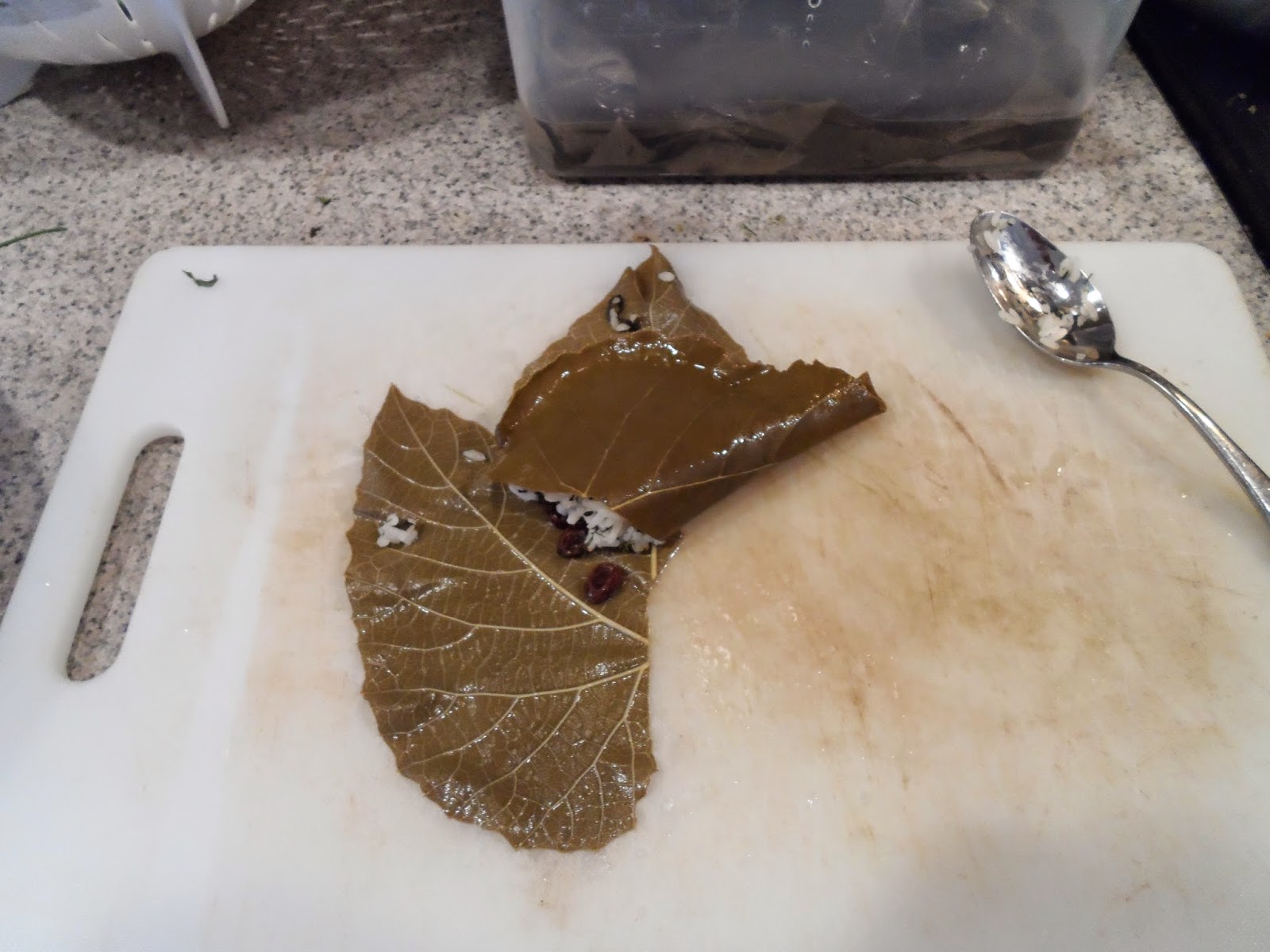

Fold the sides.

Roll.

Once the grape leaves are wrapped, place them in a Dutch oven
and cover them with water about half way up the leaves, and finish by covering
them with a few leaves.


Simmer the water and cover until the liquid evaporates,
about 30 minutes.
Cool and then eat.
Iced Sumac Tea
(Note, avoid poison sumac; it's pretty rare and looks different--white flowers instead of red ones--than the edible kind but check this link to see what it looks like.)

I simply place the sumac buds into a pot of water, four cups
or so.

Then I place this in the sun and let it steep for about an hour. Every
now and then, I squeeze the buds, bruising the flowers and pushing out the juices.

Once finished, pour the liquid through a strainer (I use a
coffee filter placed in a halved milk carton) into a pitcher with some ice.


You can add sugar or not. The lemony taste will amaze you. It's
wonderful.
Subscribe to:
Posts (Atom)