Labels

Showing posts with label Wild Edibles. Show all posts

Sunday, June 28, 2015

On Suburban Maryland Roads: Hunting for Berries, Bypassing 'World Famous' Strip Clubs, Suffering Poison Oak (On the Forehead), Finding a Fox Finding Me, Reflecting on the Addiction of the Finder's Joy, and Returning with the Booty


We were visiting my sister, Jennifer, from our home in Holyoke, and once we arrived, I  headed outside to have a look around. My sister and her family (a husband named Dave and a baby daughter named Bridget) live in a suburban neighborhood just outside of Baltimore, on a street shaped like an oxbow, a tiny teardrop of a road branching off of the Patapsco River.

Out back, there's a sump and along its edge a patch of woods where I guessed I might find some berries. Starting here, I quickly noticed one of my favorites, blackberries. It was a bit early in the season, so my son, Paddy, and I had to search up and down the thorned canes to find the darker berries. We did, picking several mouthfuls and then continuing our search.

Through a tiny path at the end of the street we headed, stepping over a steel culvert that directed a stream towards the river, and walking into a development of row houses. Here, we picked our way through bramble after bramble that framed the road, and not far ahead, we spotted low-growing bushes with light-green, oval leaves, and on the end of each branch, blueberries.

We paused, admiring our find. A low-bush blueberry is only a little bigger than a pea, so to get as much flavor as possible, we filled our palms with them before eating a handful. Cars slowed to watch the two grazers, and I got the sense they didn't know about all the wild fruit growing outside their doors. (Or, they were wondering about these two out-of-towners picking all their berries.)

Either way, their watching eyes didn't slow us down. Because once you start picking, it's hard to stop. It's an obsession that isn't just about the sweet reward. Before your tongue even bursts that perfect berry against "your palate fine," some other joy pops in your brain when you see the reward; this happens a moment before you pluck the berry from its vine, and it's this finder's joy that charges your search.  I suspect some ancient evolutionary response wants to keep us scavengers out there in the hot sun hour after sweaty hour hunting for food-- and the addiction works!

In fact, I was so intent on foraging that I not only ignored the nosy neighbors but I even missed the poison oak when its oily leaves brushed my forehead as I rooted through the berry bushes. Yes, I said "my forehead!" And by nightfall, blisters bubbled up, one pimply pocket at a time.

But all this came to pass much later. In the moment, under the sun, on the wood's edge, my son and I were in bliss. Happily we noshed. Eventually, we had to drag ourselves away from the blueberry patch and out towards other finds.

We headed up and out of the townhouses and onto a busy main road.

Across from us was an 84 Lumber and beside that, a storage facility and a do-it-yourself car wash. Stretching down the road was an occasionally-gapped wall of other one-story businesses: a recycling center, asking for brass, copper and aluminum, a restaurant called Beefalo Bob's with a flashing neon sign advertising karaoke night, a strip club with dark-mirrored windows (one shattered) calling itself The World Famous McDoogles, a bail bondsman offering "the lowest" interest rates and a little farther down, beside a tiny drawbridge, a marina peddling steamed Maryland crabs ("too pricey," my sister said) and a tiny one-room wings and sub shop (in a spot where "restaurants go to die"). Behind the stores was a backdrop of woods where two industrial smokestacks puffed out white clouds of steam. High-power lines stretched back to the smokestacks, making a greenway where one evening I spotted a red fox watching me.


Paddy and I walked a little ways and then turned off the main road and headed back towards my sister's, where we stopped at some abandoned buildings. "Check that out," I said. The white-stucco shacks were once summer bungalows. As my sister explained, many of the neighborhood's bungalows were long ago purchased by factory workers from Bethlehem Steel (at a time when the Patapsco River was polluted and river-front property was cheap) and they are now being purchased again, torn down and turned into million-dollar homes, squeezed onto tiny water-front plots on a river more pristine.

These three shacks sat in a line down to the river's edge. Their yards were overgrown with sumac and oak and another tree which had what looked like four-foot-long pole-beans hanging down. Vines wound tightly around the trunks. Green plants of various types--some blossoming yellow and white flowers--covered where grass once grew, and along the edge of the road were the last fruits of the day, mulberries.


I jumped and grabbed a tree branch, pulling the berries down to us and soon our fingertips were stained with the dark purple juice. After picking the lower branches clean, we stood under the tree, looking up at mature berries hanging from the higher branches. "I can climb it," my son said. Although he's only four, I didn't doubt him, and I considered giving him a boost to help him scale up to the enticing upper berries.

But I thought better of it and walked back to my sister's.


Sunday, April 26, 2015

Ramp Recipes--Told Super Fast


My four-year-old is begging for the laptop. My almost one-year-old is pulling down the curtains. And this is my life. So, if I am going to blog I must be quick. So hear it is, three ramp recipes told super quick.

1st-- Ramps are wild leeks. They grow mostly in neutral damp woods, best spot under maples.

Recipe 1-- Ramp bread.

Dough

3 cups flour.
2 teaspoons yeast.
2 teaspoons salt.

Mix in food processor, add water until dough is a wet ball, drop in oiled bowl, shape into a ball (it should be really sticky), wrap with plastic, let rise about 3 hours.

Ramps

Quickly saute greens and bulbs in a little oil to soften up and take some of the bit out of. Set aside and let cool.

Ramp Bread


After first rising, lay dough ball flat on floured surface, rub ramps over the top (as if it's a pesto pizza), kneed.

I kneed in a circle, working around the dough ball and pressing it down with the heel of my hand.

Kneed one full circle or so. Shape dough ball into the bread you want. Place on floured baking sheet. Lightly flour and cover with a small towel. Let rise for another hour.

Take out after one hour, Slice top three or four times with knife. Make an egg wash with egg whites. Brush wash over the bread; this will give it a brown color.

Preheat oven at 450. Place in bread. Spray or flick some water on the walls to create a humid chamber. Cook for about 10 minutes.

Lower heat to 350. Cook for another 20 min. or so, until when you knock the back of the bread, it sounds hollow.

All done!

Next- Ramp Pesto (I have to move faster; my kids have blankets over their heads and they are walking into walls.)


Place ramp bulbs and greens in food processor. Pulse until finely chopped.

Add what you like: Olive oil. A little honey or sugar. A pinch of salt. A little pepper. Pine nuts if you want (I don't). A sprinkle of Parmesan cheese.

Enjoy!

Last (and my favorite)-- Pickled Ramps

Pickle Solution

2 cups of water.
1 cup of vinegar.
1 cup of sugar.
2 table spoons of salt.

Boil until everything dissolves.

Meanwhile, cut off ramp bulbs at about one inch, make sure to include the red spot at the stem. Blanch and then place in pickle jar.

Pour hot pickling solution over ramps. Let cool. Seal. Refrigerate. Love.

That's it! Forgive the typos. My kids just walked (and crawled) out the front door. I'm off!

Friday, April 24, 2015

Finding wild ramps (I think) on a strange and beautiful hike


We stood at the top of a steep hill, just off an abandoned railroad track. This was the spot. I had noticed it from the road and had a feeling we'd find ramps here. I looked around: no pines (ramps dislike the acidic soil pines grow in). A corroded pipe jutted out from the embankment near the street, allowing a stream to pass underneath and into the tiny valley. Ramps grow in such moist soil.

Paddy and I climbed down, digging our heels in with each step. Once down, we had to cross a bridge made by a fallen tree to get to the other side of the stream. It was about six feet up and Paddy carefully balanced his way across, while I followed behind.

On the other side, we began to roam.

Paddy found an uprooted oak tree and I told him that some people believe such roots are the best place to look for rare rocks and long-ago buried treasures. He went to work poking his hand into the roots, searching for his treasure.


We soon continued on and I noticed some light green leaves, in a small patch, poking from the ground. I immediately knew they were ramps. I snapped one at the root and smelled. Ramps are a wild leek and they smell like onions. I smelled onion.

I looked around and saw a few other patches. I dug up a few plants in each, careful to leave enough to go to seed, so they could produce more later on. I stuffed the ramps in my backpack next to some garlic mustard I had already picked and we moved on towards the culvert that Paddy wanted to check out.

The ramps were the climax of a strange hike, marked by beautiful and weird sights, like a miniature forest of tiny white flowers ...


and a root that looked like a giant snake ...


and the abandoned house crushed by a tree, set right in the middle of the woods ...


and a sea of mesmerizing plants growing from the leaf litter ...


Finding ramps would have been a perfect finish and I had big plans. I wanted to pickle them with some fiddleheads I plan to pick in a couple of days. We quickly headed home, with Paddy in the lead.


My plans lasted the whole way, until we reached home. This was when I called out to Lisa.

"I found ramps!"

She was on the couch with Gabo sleeping on her chest. I brought her in one to smell.

"Smells like onion, right?"

"I don't smell onion," she said.

What did she mean? How could she not smell onion?

I smelled it again. The scent was not as pronounced as when I picked it in the woods, but I smelled onion.

But now, I needed to be sure. Lily of the Valley looks like ramps and is poisonous. I read online that sometimes when you pick ramps with garlic mustard, the onion scent is from the garlic mustard, not the ramps. "So be careful" was the message.

I wasn't so sure anymore.

I grabbed one of my books. It said that ramps have a red or purple color at the base. Mine were pure white; it was not looking good. I decided to bag the "ramps" for the day. Tomorrow, I would bring them to my father-in-law, Thom Smith, a nature writer who lives in Pittsfield. He'd know.

To be continued ...

Monday, April 20, 2015

Spring's First Forage

The fiddle heads have almost popped up from last year's stems. My four-year-old son, Paddy, and I found them last year in a gully down by the Connecticut River. The gully is made by a culvert that runs under East Street in Easthampton, and last year we found the massive ostrich ferns, fully unfurled and filling in the tiny valley. Soon the furled fiddles will be ready to be picked. I haven't cooked them before so I'm looking forward to see how they taste.


Along the way we also found garlic mustard, good for a bitter pesto that I tame by adding a little sugar, and what I believe is immature watercress growing in a tiny intermittent stream running alongside the Manhan Bike Trail. We couldn't be sure about the watercress so in the end we didn't' eat them; if you can help me identify them, they're the last picture.


Wednesday, July 30, 2014

Wild(ly good!) Meals: Stuffed Wild Grape Leaves & Iced Sumac Tea


With a summer thunderstorm yet to arrive, Patrick and I decided to head out, he secure in the back carriage as I pedaled the bicycle. My backpack held two plastic grocery bags, a small shovel, scissors, and a camera. I knew we'd have no problem finding the food we were after: wild grape leaves and staghorn sumac, both abundant on roadsides.
We rode around the corner, the back tire flicking up an arc of water from rain puddles (Patrick's carriage had a plastic windshield) and soon we stopped at a grapevine, twisted and clinging to black raspberry bushes, which Patrick and I had picked clean about two weeks earlier.


I plucked about 15 leaves as Patrick sat eating an apple in the carriage. I threw the shiny leaves in a plastic bag and pedaled on.
In no time, I saw the sumac, its distinctive red buds erect on the branches' ends. I pedaled over, reached up and grabbed a few branches, pulling each down in turn and snipping off their red flowers.


I dropped them in the backpack and then rode off again.
Having the plants we set out for, we just coasted around, feeling the warm humid breeze and watching all around.
Here's a pretty field we passed on the way.


And here are the recipes.

Stuffed Wild Grape Leaves
(Avoid common moonseed. It's poisonous, but you can easily avoid it.)


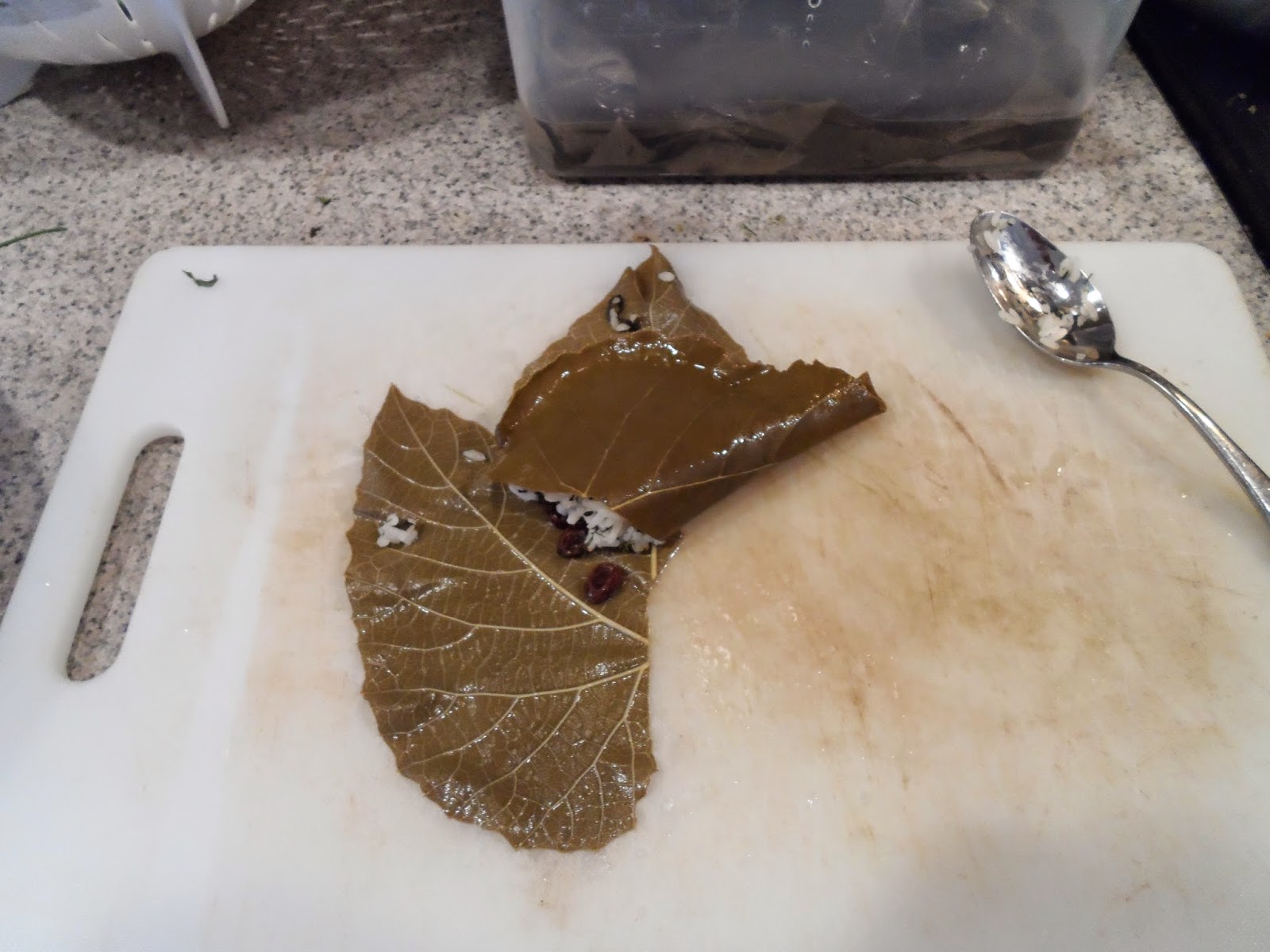
I start by boiling rice in salted water. I use a little extra water and boil a bit longer so the rice is sticky when cooked. Once finished, I mix the hot rice in a bowl with raisins and minced dill, basil and mint. I add salt and pepper until I like the taste. Sometimes, I sprinkle in a bit of cumin, too. Set aside.


I cut the stems off the grape leaves. You can save time by stacking a few on top of each other and cutting the stems off at the same time. 


Don’t stack too many, though, or you will cut too much off the bottom leaf.
Then, I blanch the leaves for about 10 minutes.
My Lebanese grandfather Ismael Ramadan (best name ever) taught me to pickle the leaves in vinegar before wrapping. You can skip this step, but the vinegar flavors the wraps with a nice tang.


I then place the leaves glossy side down on a table and scoop about a table spoon of the rice mixture onto the center of the leaf and then wrap using this process:


Fold the rear.


 Fold the sides.


Roll.


Once the grape leaves are wrapped, place them in a Dutch oven and cover them with water about half way up the leaves, and finish by covering them with a few leaves. 


Simmer the water and cover until the liquid evaporates, about 30 minutes.
Cool and then eat.

Iced Sumac Tea
(Note, avoid poison sumac; it's pretty rare and looks different--white flowers instead of red ones--than the edible kind but check this link to see what it looks like.)


I simply place the sumac buds into a pot of water, four cups or so. 


Then I place this in the sun and let it steep for about an hour. Every now and then, I squeeze the buds, bruising the flowers and pushing out the juices.


Once finished, pour the liquid through a strainer (I use a coffee filter placed in a halved milk carton) into a pitcher with some ice.


You can add sugar or not. The lemony taste will amaze you. It's wonderful.


Sunday, July 13, 2014

Kale Chips, Day Lily Tempura, Pea and Swiss Chard Timbale

I had turned my car around, but not for the wild day lilies. Instead, a beach chair caught my attention; mine had ripped. Yet, when the chair had no "free" sign on it, I decided to walk a little farther to a patch of woods where I had noticed some common day lily buds poking out from tall grass along the road's edge. I plucked a handful and headed home. I was feeling confident, having already cooked kale chips for my son and his two friends earlier in the day-- and they loved them. The approval of a three-year-old is better than the approval of any food critic. With that encouragement, I decided to further my culinary adventure and cook day lily tempura with pea and Swiss chard timbale.
Sounds fancy, but it's not. Here are the recipes:


Kale Chips 


1. Cut the leaves from the stems of the kale. I love kale stems, but in chips they're too chewy.
2. Chop the leaves into chip-sized pieces.
3. I like to get the oven pretty hot, at 425 degrees. Preheat.
4. Spread chips on cookie sheets; you'll most likely need more than one. I usually cook a few batches.
5. Drizzle some oil over them. I use Canola.
6. Cook until the edges of the kale brown.
7. Sprinkle some salt over the top, mix them up a bit, and serve.

Day Lily Tempura

These are common day lilies. I usually see these growing along the sides of roads. Pick a few buds, before they blossom.
1. Make an egg batter. I season mine with a little Parmesan cheese and pepper.
2. Put some flour in a bowl, mixing in dried oregano.
3. Dip the lilies in eggs and then flour and fry.
5. Once they're golden brown, take them out and pat them down with some paper towels.
6. I sprinkle them with a little salt and drizzle a little lemon juice on top.

Pea and Swiss chard timbale
A timbale is a dish made in a mold. We'll make a breadcrumb mold for this dish.

1. I used sugar snap peas, and just chopped them up.
2. Chop up the chard. Use the stems, too.


3. Saute the stems first in a little hot oil, a tablespoon or so. They'll need a little more time to soften. You can saute them with a little garlic or onion if you like.
4. Drop in the peas, and saute for a few minutes.
5. Last drop in the chard leaves, cover the top and place the burner on medium. Let the chard cook down to about half its original size.


7. While that cooks down, butter the bottom and sides of a somewhat deep loaf pan. Cover the butter with breadcrumbs. I buy the seasoned type. If your breadcrumbs are not , mix in some dried oregano, basil, and whatever else you like. Experiment.
8. The pan should be coated with breadcrumbs; this will become your mold.
9. Meanwhile, in a large bowl, crack two eggs and a mix of herbs, finely chopped. I picked basil, oregano, mint, chives, some herb whose name I do not know (it's really peppery), and some garlic leaves. Mix this up with eggs.


10. Drain excess water out of the peas and chard and then drop them into the herb mixture.
11. Last, drop everything over the breadcrumbs in the loaf pan. I like to sprinkle a little Parmesan cheese over the top.
12. Cook for about an hour. Once done, flip the loaf onto a plate, praying the mold holds. (I'm serious; the prayer part is vital here.)


Here's the final dish. It doesn't look pretty, but it tasted damn good.

Pea and Swiss chard timbale with lily tempura. 


Wednesday, July 9, 2014

Hiding in Plain Sight: Little Green Visitors Arrive

I had planned to yank them all from the dirt and toss them into the compost pile. They looked like clover. Delicate little greens with a yellow bud readying to bloom. To me, they were weeds.


Luckily, the 90-degree high-humidity weather kept me from doing yard work and the weeds remained rooted.

The following day I took a walk with naturalist John Root in some woods behind his home. Root stopped every few feet to point out wild edibles (stinging nettle, violet, black raspberry, amaranth, lambs quarters, purslane), but it was the plant he picked almost as an aside that caught my attention.

"Here," he said, bending down near a compost pile along a trail. "It looks like a clover, but it's wood sorrel."

I looked in his hand and saw the "weeds." I picked one and the taste was a shot of lemon. When I returned home, I picked a handful and shared it with my family. I was thrilled.

Then I decided to walk through my yard to note what other wild edibles were growing just outside the front door. The first one I found was lambs quarters, just a few sprouting from un-weeded spots in the garden. This green is succulent and crisp and as nutritious as spinach.


I also had a small patch of plantain growing in my lawn, their tiny green leaves continuously re-growing after I mow the lawn. You can use these in a stirfry.


Then, the final gift was a wild black raspberry. I'm not sure where they came from, but there they were, twisting their thorny vines up the chicken wire fence of my garden. I grabbed a few and headed back inside for a taste.


Of course, these green (and black) visitors were always there. The only difference is now I can see them. I wonder what I else is hiding in plain sight.